Light, Space and Time
(or the physics of Duality & Causality)
From high-school physics we know that Light is special. It travels through space and time at an insanely high speed (~300 million meters per second). Unlike sound, it is a wave that can propagate in a vacuum. If you were attentive in school, you might even remember how the forces of Electricity and Magnetism together reinforce each other in Maxwell’s equations to create a propagating wave, which we call Light.
But let’s try to understand the deeper mysteries behind this simple phenomena. I would call this essay a success if at the end of it you understand, at a fundamental level, how light behaves in our universe. How Einstein tied it together with space and time in his Special Theory of Relativity. And what it reveals about the underlying structure of our universe, and which rules that we intuitively imagine are fungible and which ones are sacrosanct.
Travels in what?
If you have ever run across magnets as a kid, I’m sure you would remember how fascinating they are. They can attract and repel each other across “nothing”. You can try to force two north poles together and feel this force pushing against you, with no physical object in between. One might think they are just “pushing” the air around them, like we use leaf blowers to move leaves without touching them. But if you were to take these same magnets in a vacuum with no air, no medium, they would still behave the same way.
We also know that electricity and magnetism are inter-related. A moving electric charge (electric current) leads to a magnetic force, and a moving magnet can induce an electric current. Almost all the electricity we use comes through moving magnets around, using flowing water, wind, or steam generated by burning fuel (be it coal, diesel or uranium).
We say that these magnetic (or electric) forces travel through a “Magnetic Field”, that can be visualized by throwing tiny iron fillings around a magnet. But the idea of a Field is just an abstraction; a mathematical model that we have to describe “what the force would be at this particular point if we place some object here”. And it gets complicated if that object is moving, because it is then suspect to the forces of two separate fields.
The actual mechanics are described well by Maxwell’s equations on why oscillating an electric current to-and-fro leads to fluctuations in both the electric field and magnetic field. These fluctuations are sustained through long distances. This is what we see as visible light. This is what leads to microwaves, radio, X-rays and so on all depending on how many oscillations happen in a second.
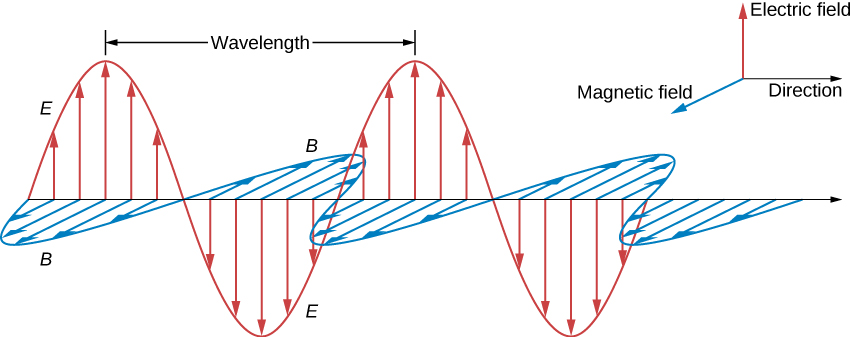
Now, every wave we know from everyday experience needs a medium. If you’ve ever seen a boat moving across a lake, you know it leaves ripples behind. The water itself doesn’t travel, it just bobs up and down as the wave of energy passes through. Similarly, when you speak, air molecules bunch up and spread apart, carrying sound to someone’s ear.
So it seemed perfectly reasonable to think that light or EM waves must also travel through some medium. Scientists in the 19th century called this hypothetical substance the “luminiferous aether”. They imagined it as an invisible, transparent substance pervading all of space, through which light waves could ripple just as sound ripples through air. After all, if light is waving, something must be doing the waving, right?
But here’s where reality surprised us. In 1887, Michelson and Morley conducted an experiment to detect this aether. The idea was simple: Earth is hurtling through space at tremendous speed as it orbits the Sun. If there’s an aether filling space, Earth must be moving through it, like a boat cutting through water. Stick your hand out of a moving car window and you feel wind rushing past your face. Similarly, if we’re moving through an aether, we should detect some kind of “aether wind” when we measure the speed of light in the direction of earth’s motion versus in the direction perpendicular to it.
They built an incredibly sensitive apparatus to measure the difference. The result? Nothing. No difference whatsoever. No matter which direction they measured, light traveled at exactly the same speed. It was as if Earth wasn’t moving through any medium at all.
This was deeply puzzling. Other experiments confirmed the same result. The conclusion was unavoidable: there is no luminiferous aether. Light truly travels through nothing. Through empty space. Through vacuum.
In my opinion, it feels intuitive to think of a medium for Light and electricity and magnetism, even if that medium is “transparent”, but reality has responded to us saying no. But having an aether would have violated other intuitions we have too.
Imagine you’re conducting experiments inside a train moving at constant speed. You toss a ball up and catch it. You watch how magnets attract each other. You shine a flashlight. Everything behaves exactly as it would if the train were sitting still at the station. You can’t tell, from inside the train with the curtains drawn, whether you’re moving or stationary.
This makes intuitive sense. Motion is relative. When we say Earth is moving at 30 kilometers per second around the Sun, we mean it’s moving relative to the Sun. But from Earth’s perspective, we could just as well say the Sun is moving around us. There’s no privileged “rest frame”—no special stationary point in the universe against which all motion should be measured.
But if an aether existed, it would create exactly such a privileged frame. The aether would be “at rest”, and everything else would be moving through it. You could, in principle, measure your absolute velocity by checking how fast you’re moving through the aether. This feels wrong. Why should the universe pick out one special reference frame and make it fundamentally different from all others?
So in a way, the absence of aether preserves something beautiful: the idea that all constant motion is relative, that there’s no absolute stationary reference point in the universe. Physics should look the same whether you’re standing still or moving at a constant velocity. The magnets in your hand should attract each other the same way on a moving train as they do on the platform. Light should behave the same way too.
But if light doesn’t travel through a medium, and if there’s no special rest frame, then we’re left with a puzzle: how does light work? And more importantly, what does its speed even mean if there’s no fixed reference point to measure it against?
Who is measuring it?
So light travels through nothing, and there’s no special rest frame in the universe. But here’s where things get really interesting.
You’re standing on a platform, and I’m on a train moving past you at half the speed of light. I shine a flashlight forward. You measure the light traveling at 300 million meters per second. I measure it at exactly the same speed. 300 million meters per second.
This makes perfect sense when you remember what we just established. There is no aether. When I throw a ball forward on the train, you see it moving faster than I do because the ball is moving through air, and velocities through a medium add up. But light isn’t moving through anything. It’s propagating through the electromagnetic field itself, through vacuum.
The speed of light isn’t arbitrary. It falls directly out of Maxwell’s equations. It depends on two fundamental properties of empty space: electric permittivity and magnetic permeability. These are constants of the vacuum itself. They don’t change whether you’re moving or standing still, because there’s no medium to be moving through.
So of course we both measure the same speed. The universe has physical properties, written into the fabric of vacuum itself, that determine how fast electromagnetic waves propagate. This speed doesn’t depend on who’s measuring it or how fast they’re moving.
But wait. If we’re moving relative to each other, and we both measure light at the same speed, something has to give. When you’re on that train and I’m on the platform, we can’t both be right about distances and time intervals and also agree on the speed of light unless we’re measuring different distances and different time intervals.
And that’s exactly what happens. Your rulers measure different lengths than mine. Your clocks tick at a different rate than mine. Space and time themselves are not absolute. They’re flexible, adjustable, whatever it takes to preserve this one sacred rule: the speed of light is the same for everyone.
The universe picked its fundamental constants. Electric permittivity. Magnetic permeability. These determine the speed of light. And once that’s fixed, everything else, space and time themselves, have to bend to accommodate it.
Everything moves at Speed of Light
Here’s something that will sound crazy at first: you are traveling at the speed of light right now. You’ve been doing it your whole life. You just don’t notice it because you’re moving through time instead of through space.
Let me explain. We usually think of space and time as separate things. There are three dimensions of space (left-right, forward-backward, up-down) and one dimension of time (past-future). But Einstein showed they’re not separate at all. They’re woven together into a single four-dimensional fabric called spacetime.
Every object in the universe, including you, is always moving through this four-dimensional spacetime at exactly the speed of light. Not approximately. Not close to it. Exactly at the speed of light. This is a fixed speed limit for existence itself.
Right now, as you sit reading this, you’re hurtling through spacetime at 300 million meters per second. But your velocity is aimed almost entirely in the time direction. You’re moving through time at nearly the full speed of light, which is why you experience time passing at the rate you do. One second per second, as we say.
When you start moving through space (say, you get up and walk), you’re redirecting some of your velocity from the time direction into a space direction. You’re still moving at the speed of light through spacetime, but now less of it is pointed toward time and more is pointed toward space. This is why time slows down for moving objects. They’re using up some of their “speed budget” to move through space, leaving less for movement through time. Of course, this is only noticeable for objects like GPS satellites, which are moving fast enough that we have to be careful when thinking about their time versus our time.
Let me show you a simple picture to make this concrete:
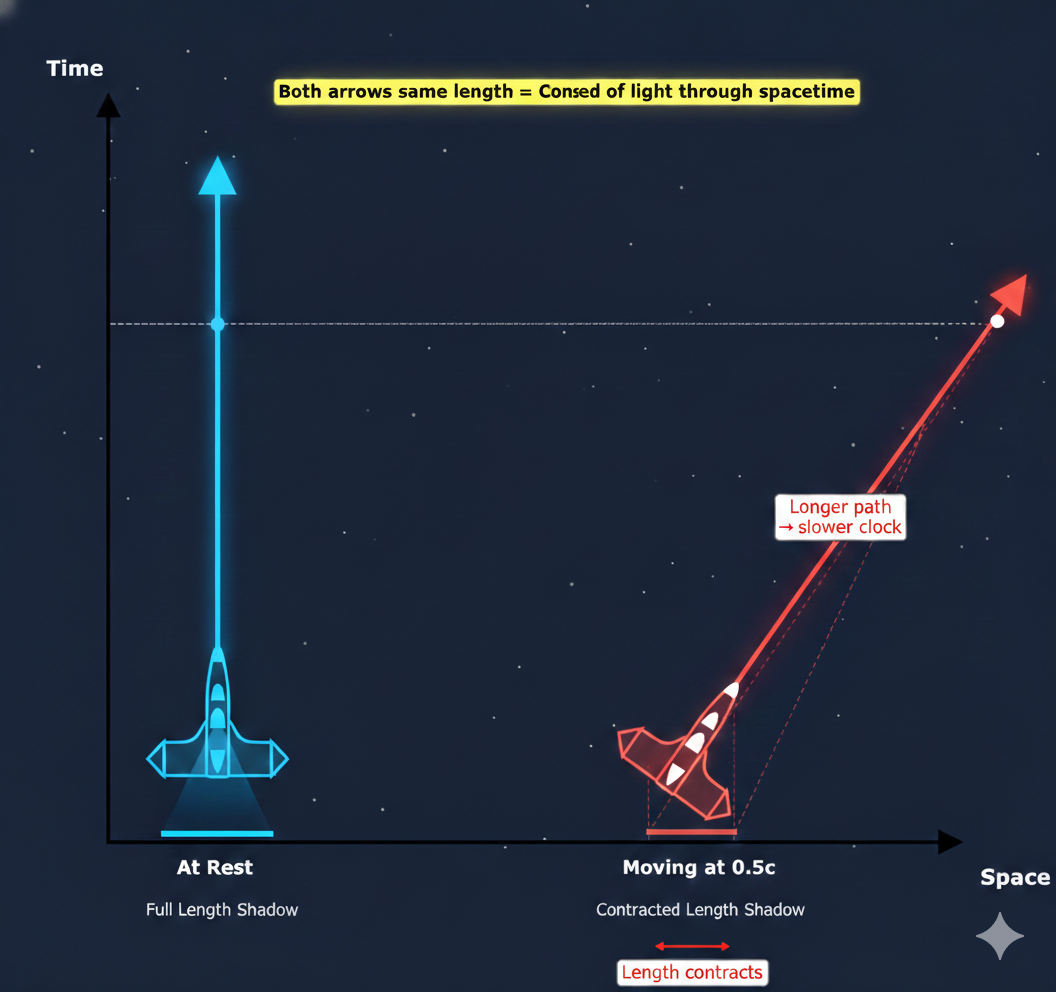
Here’s the diagram. On the left, the plane is at rest, with all its velocity pointing through time. On the right, it’s moving through space, so its velocity arrow tilts. The arrow length stays the same (speed of light through spacetime), but now it’s split between space and time directions. The dashed lines show how its spatial extent appears contracted when you project it onto the space axis.
This tilting of the velocity arrow is what causes all the weird effects. Less velocity in the time direction means time passes slower for the moving object. The spatial projection being shorter is length contraction. This isn’t just theory. That phone in your pocket has to accommodate for these effects every time you use Google Maps to check where in space time you are relative to a bunch of satellites hurtling in earth’s orbit at insane speeds, sending you packets of information as invisible light.
Light is different from us in a fascinating way. It too of course travels at the speed of light but it’s pointing all its velocity in the 3 directions we see as space. But this doesn’t mean photons don’t experience time or causality. For light, the direction of its travel is what unfolds as “time” for it. Cause and effect still happen along its path. It can be emitted, travel, interact with matter, get absorbed, all in a sequence of events that make sense. It’s just that this sequence unfolds along its direction of motion.
All of the above is beautifully explained in this video which I highly recommend watching to solidify your intuition.
Objects with mass (what we call “inertial mass”) can never redirect all their velocity into spatial directions, as that requires infinite energy. They always keep some velocity pointed toward time, which is why they always experience time passing and why they can never reach the speed of light through space. Light is special. It is free to pick its direction, so all energy you put into it goes towards whichever spatial direction you choose. It has no “inertia” to stick to one direction, thus no inertial mass.
Cause -> Effect
Here’s something that might worry you: if space and time are flexible, if different observers disagree about when things happen, if simultaneity is relative, then surely the universe must be chaos? How can anything make sense if we can’t even agree on the order of events?
But here’s the beautiful part. We can disagree about simultaneity, but we can never disagree about causality.
Let me explain with an example. You’re standing on a platform. I’m on a train moving past you. A light bulb on the train flashes, and then, a moment later, a bell on the train rings. From my perspective on the train, the flash happened first, then the bell. From your perspective on the platform, accounting for your motion relative to me, you might measure different time intervals between these events. You might even measure different distances between where they occurred. But you will never, ever see the bell ring before the flash. The order of cause and effect is preserved.
This is because of that speed limit we discussed. Information, influence, causality itself, cannot travel faster than light. When the light bulb flashes, that event creates a “light cone” expanding outward at the speed of light. Only events inside this cone can be causally connected to the flash. The bell ringing is inside that cone. So no matter how you’re moving, no matter how much your space and time are squished or stretched, you’ll always see the flash happen before the bell.
Think of it like ripples in a pond. You drop a stone, and ripples spread outward. A leaf floating nearby will bob up and down after the ripples reach it, never before. You can watch this from the shore, or from a boat moving across the pond, or from a helicopter above. You might measure different speeds for the ripples depending on your motion, but you’ll never see the leaf bob before the stone hits the water.
In our universe, causality propagates at the speed of light. Every effect had a prior cause. How much prior, and where exactly in space, can change depending on who is looking and how they’re traveling through this four-dimensional spacetime. But the causal order, the sequence of cause preceding effect, remains inviolable.
So yes, we have to let go of some intuitions. Space is not an empty, unchangeable container. Time is not exact like clockwork, ticking away the same for everyone. But what we keep, what the universe preserves at all costs, is causality. Events still unfold one after another. The past influences the future, never the reverse. This is the deeper structure, the more fundamental rule that reality refuses to violate.
Locality
This speed limit on causality has profound implications. It means that nothing can affect something else instantaneously across a distance. Everything is local. Objects influence each other in their neighborhood, not across the cosmos in zero time.
When you push a book across a table, you’re not reaching through empty space to move it. The atoms in your hand get close to the atoms in the book, close enough that electromagnetic forces (which propagate at light speed) can push those atoms, which push the next atoms, and so on. The influence travels through the material at some finite speed, ultimately limited by light.
When the Sun suddenly disappeared (hypothetically), we wouldn’t know for about eight minutes. Earth would continue orbiting the spot where the Sun used to be for eight minutes before the gravitational influence of its absence reached us. Light and gravity both travel at the same cosmic speed limit.
This locality is what shaped our universe. After the Big Bang, everything was pushed outward at speeds approaching light. But not everything moved in exactly the same direction. Tiny quantum fluctuations, small differences in velocity and direction, meant that some regions of space had slightly more matter than others. These regions, through gravity, pulled on their neighbors. But only their neighbors. Only the matter close enough that gravitational influence could reach it before everything spread too far apart.
This is why matter clumped together into galaxies, stars, planets, instead of spreading uniformly through space. Locality. Causality. The speed limit says you can only affect what’s near you, and only after enough time has passed for that influence to reach them.
This is also why we have multiplicity instead of unity. Why the universe is full of separate things rather than remaining as one undifferentiated point. If influences could travel instantaneously across any distance, if causality had no speed limit, everything would still be connected as it was at the moment of the Big Bang. There would be no separation, no locality, no distinct objects. Just one eternal moment of everything happening everywhere at once.
But we don’t live in that universe. We live in one where locality reigns. Where cause must precede effect. Where influence takes time to travel. This is what creates the structure we see. Galaxies separated by vast distances. Stars burning their fuel over billions of years. Planets forming and evolving. You, sitting here, reading this, as a distinct entity separate from the screen, separate from the room around you.
🪷 All is Unfolding 🪷
The whole universe doesn’t go from the Big Bang to cold death in a single instant. It unfolds. Things happen here, then there. Now, then later. This locality and causality is what gives rise to the duality in our world. Not a philosophical duality, but a physical one. The separation between subject and object. Between here and there. Between now and then.
Without the speed limit of light, without locality, without the constraint that everything hurtles through spacetime at this fixed cosmic speed, there would be no structure. No stars. No planets. No evolution. No life. Just an undifferentiated ball of energy, existing everywhere and nowhere, in no time and all time, with no cause, no effect, no story to tell.
The speed of light is not just a speed limit. It’s the speed of the totality unfolding and flowing. It is the constraint that makes this pluralistic existence possible. And dare I say, it is beautiful.
The alternative that humanity imagined was the mechanistic Newtonian world with a luminferous aether. Where light was not special. Where we could define absolute rest. Where time was a guardian separate from our space and went tick-tock, the same for everyone. This universe of absolutes might sound “proper”, but it also feels like we are puny playthings under the watchful eye of the grand laws of Time and Space.
I personally, am glad that we find ourselves in a universe where causality (or Karma) is the only fundamental, and everything else is a natural Unfolding. And as we will hopefully see in the next article, this Duality is illusory too.